


Most organizations that invest seriously in business process management reach a documented, repeatable level of performance and then stop advancing. Many BPM programs are “mature on paper” but stuck in practice. This article maps the five BPM maturity levels, explains why Level 3 is where the majority stall despite continued investment, and gives you three questions to diagnose whether your process governance is structurally functional — or just formally in place.
If your process owners have the title but not the authority, this article is about you.
The Data
Recent BPM studies suggest that only a minority of organizations progress beyond early-to-mid BPM maturity, and that overall distributions have changed little between 2023 and 2025. The 2025 BPM study by ZHAW School of Management and Law and BOC Group, covering almost 300 organizations in the DACH region, finds that most organizations continue to operate at lower to mid levels of BPM maturity, with only around 15% reaching higher maturity levels.
APQC’s BPM maturity benchmarks and assessment tools similarly show that many organizations remain in the lower half of maturity scales, despite having formal BPM structures in place, and report ongoing challenges in moving to more advanced levels of process governance. “Moving to process-based thinking” and embedding process management into the organizational culture recur as high-ranked challenges.
In other words: two or more years of active BPM investment often result in limited or no measurable movement in overall maturity distributions.
If methodology were the primary constraint, we would expect sustained use of established BPM frameworks to gradually translate into higher maturity scores; yet large-sample surveys show persistent clustering in early-to-mid levels. The studies cited above focus on organizations that actively invest in BPM, use formal frameworks, and participate in structured assessments, so the stagnation is not simply a sponsorship problem.
The implication is that something structural in how governance is designed and operated is constraining advancement.
The Five Levels: What Each One Actually Requires
All dominant BPM maturity frameworks — including OMG’s Business Process Maturity Model (BPMM), Rosemann and de Bruin’s BPMM, and other CMMI-inspired models — share a broadly similar five-level architecture, even if terminology differs. Hammer’s Process and Enterprise Maturity Model (PEMM) is structured somewhat differently, with an emphasis on capability dimensions, but is frequently interpreted in practice as defining staged maturity progression.
Figure 1: The Five Levels of BPM Maturity
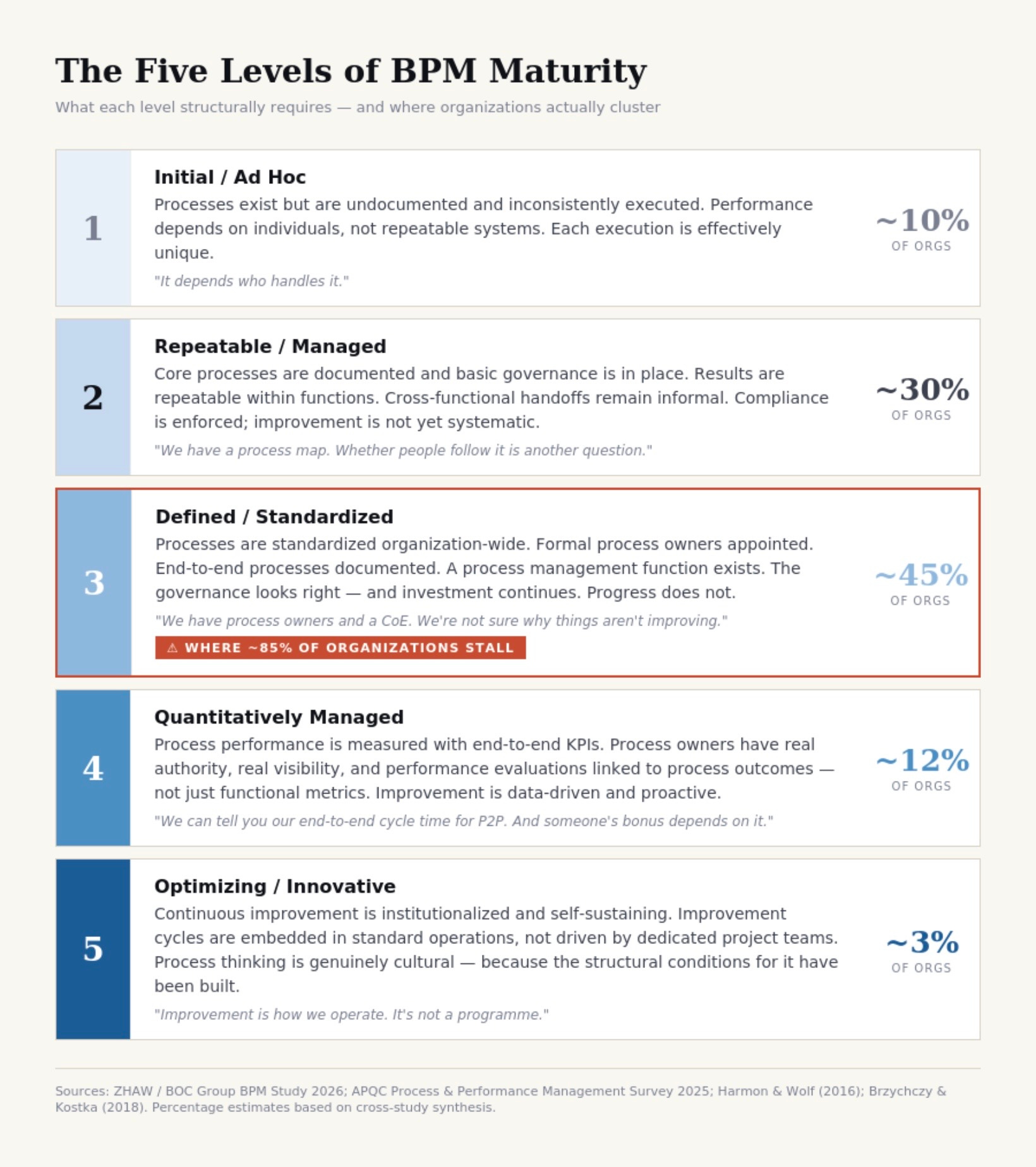
Across these models, the underlying logic is consistent: lower levels describe ad-hoc and functionally siloed practices; mid-levels describe standardized, documented, and repeatable processes; higher levels describe managed, quantitatively controlled, and continuously optimized processes. Understanding what each level structurally requires, rather than just how it is labeled in an assessment report, is essential for understanding why advancement so often stalls at Level 3.
The maturity models are detailed in describing where organizations are — they provide taxonomies, levels, and assessment criteria with considerable sophistication — but systematic reviews have repeatedly observed that they provide much weaker explanations for why organizations stall at specific levels or how to overcome structural barriers. Röglinger and colleagues, as well as Tarhan, Turetken, and Reijers, note that empirical evidence on the validity and usefulness of BPM maturity models is limited and that prescriptive guidance for progressing between levels remains underdeveloped.
Existence vs. Operationality
The progression from Level 1 to Level 3 is largely about governance infrastructure: creating documentation, defining process architectures, assigning roles, and establishing a process management function. Many organizations can reach this stage through sustained BPM investment, implementation of frameworks such as APQC’s BPM Maturity Assessment, and deployment of centers of excellence.
The progression from Level 3 to Level 4 requires something different: that the governance infrastructure actually functions as intended — that process ownership and cross-functional control mechanisms are operational, not just defined on paper. A process owner who lacks end-to-end visibility, cross-functional decision rights, and incentives aligned with process outcomes is an infrastructure element, not an operative governance mechanism; the role exists, but the governance does not.
Consider Record-to-Report. In many groups, central finance has full visibility of the consolidated picture but lacks authority to mandate changes in business unit closing procedures; business unit CFOs have authority within their silo but lack end-to-end visibility across entities. No single actor holds both visibility and authority, yet a formal “process owner” may still be appointed. In such a design, very little changes in practice; this is not a failure of individual managers so much as a structural misalignment.
Similar patterns appear in Procure-to-Pay, where procurement is measured on price variance, finance on processing cost, and operations on delivery reliability — three separate metrics for one integrated process, with no single owner accountable for end-to-end performance. And in Order-to-Cash, improving days-sales-outstanding almost always requires coordinated behavior changes across functions measured on incompatible KPIs.
Systematic reviews of BPM maturity models confirm that most frameworks concentrate on describing the presence of governance elements — structures, roles, and practices — rather than on assessing whether these elements have the visibility, authority, and incentive alignment needed to function effectively. Existing models are predominantly descriptive and lack robust, empirically validated mechanisms linking specific governance configurations to performance improvements.
The critical distinction most maturity models currently do not systematically assess is therefore not which governance structures are present, but whether those structures are operationally capable of delivering cross-functional control.
What Standard Assessments Don’t Measure
Standard BPM maturity assessments, including those used in industry surveys, primarily measure the horizontal dimension of governance infrastructure: the existence and quality of documentation, formal ownership roles, frameworks, and defined process architectures. These assessments answer questions such as: “Is there a documented process map?” “Is a process owner formally assigned?” “Is there a BPM governance framework?”
What they typically do not measure is the vertical dimension of governance operationality: whether the assigned owner has integrated visibility across all contributing functions, cross-functional investment or change authority, and performance incentives that are materially linked to end-to-end process outcomes.
You can visualize this difference as a nine-box grid.
Figure 2: Process Governance Diagnostic Matrix
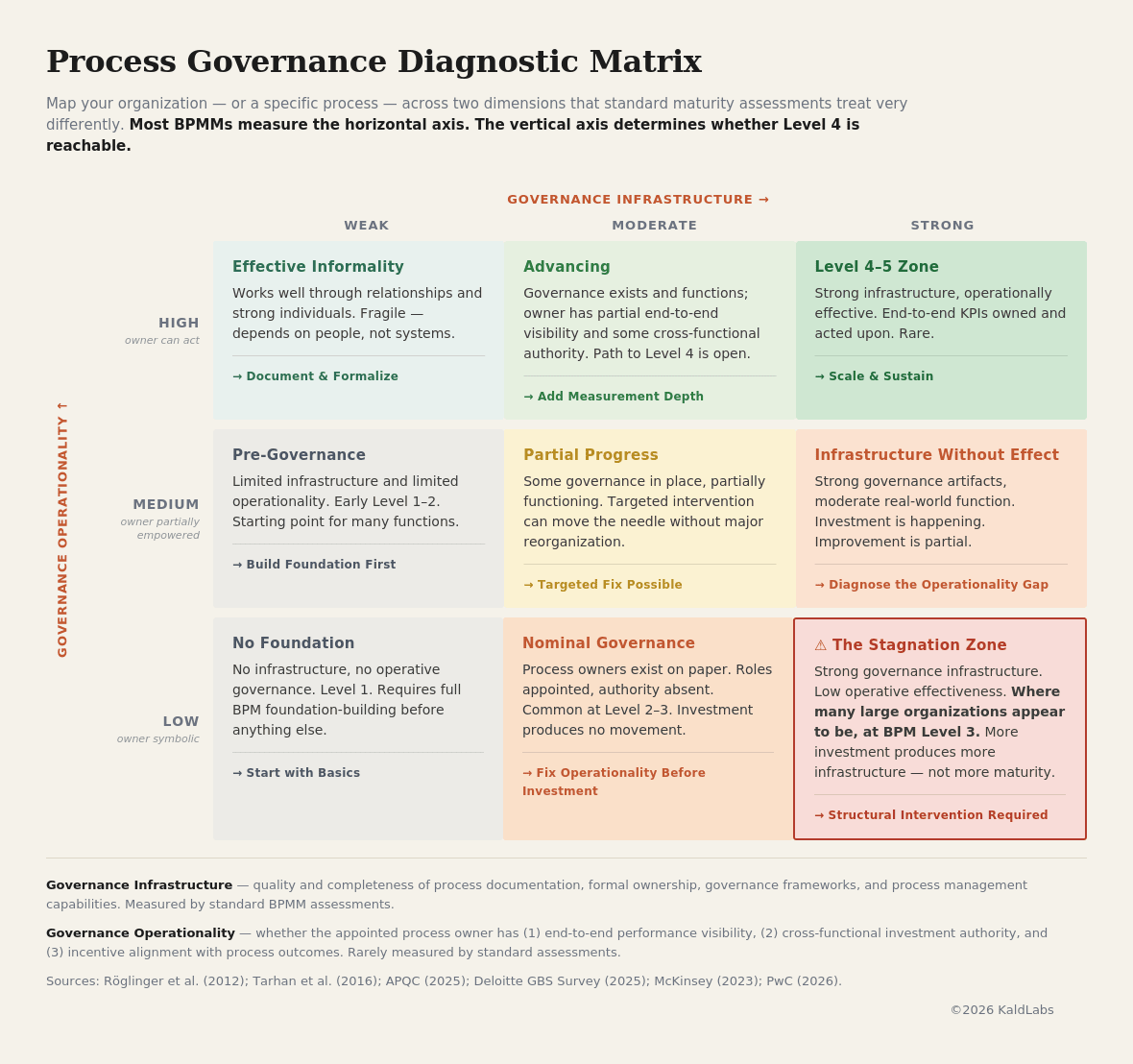
Horizontal axis — Governance Infrastructure: quality and completeness of , formal roles, and frameworks.
Vertical axis — Governance Operationality: degree to which the process owner has end-to-end performance insight, authority crossing functional lines, and incentive alignment with process KPIs.
Most large organizations with established BPM programs appear to cluster in the bottom-right cell of this grid: strong governance infrastructure combined with weak governance operationality. Public summaries from BPM studies and benchmarking collections show a prevalence of formal process structures and architectures, but continued challenges around practical end-to-end ownership and cross-functional decision-making.
In this “stagnation zone,” additional investment produces more infrastructure — better documentation, more defined roles, improved frameworks — but not more maturity in the sense of operational, cross-functional control. The governance looks correct on the org chart, while underlying authority, information flows, and incentives remain misaligned. Because standard assessments primarily measure the horizontal axis, organizations systematically underdiagnose these constraints and misallocate remediation effort.
Evidence on End-to-End Ownership
Global surveys of shared services and business services functions have for several years reported unresolved questions around end-to-end process ownership and accountability design. In Deloitte’s analyses of global business services trends, issues of cross-functional ownership, fragmented responsibilities, and unclear accountability appear consistently among the most frequently cited design challenges in service delivery models.
Similarly, work by consulting firms and academic studies on operating models regularly points to fragmented ownership as a structural barrier that precedes and amplifies other barriers such as technology limitations, local resistance, and change fatigue. Before organizations can address methodological or tooling issues, they often face unresolved questions about who actually owns end-to-end processes and with what authority.
Other reports on operating models and performance structures indicate that only a minority of organizations operate with truly horizontal performance structures that align measurement and accountability with end-to-end processes rather than functions. Horizontal structures are the exception, not the rule; most organizations continue to manage performance primarily through functional lines.
Taken together, these findings support the thesis that the appointment of process owners is common, but that these appointments often do not create the operational authority structures originally envisioned.
Three Diagnostic Questions
Before committing further BPM investment to any major end-to-end process, you can test whether governance for that process is structurally functional by asking three questions.
1. Does the process owner receive integrated performance data spanning all contributing functions — at least monthly?
Without a consolidated, end-to-end view of cycle time, error rates, and cost across functions, the owner cannot see what they are supposed to manage. Many maturity assessments verify that metrics exist, but not whether they are integrated across functions and regularly available at process-owner level.
2. Can the process owner authorize an improvement requiring changes in more than one function, without each function head’s separate approval?
If every cross-functional initiative requires individual sign-off from each affected silo, the process owner is a coordinator, not an owner. Studies of operating models and BPM governance repeatedly highlight fragmented authority and siloed decision rights as primary obstacles to realizing process-oriented changes.
3. Does the process owner’s formal performance evaluation include at least one end-to-end process KPI with meaningful weight?
Without a KPI that links the role’s evaluation to outcomes such as end-to-end cycle time or total cost per transaction, the incentive link is severed. Kerr’s classic 1975 paper, “On the Folly of Rewarding A, While Hoping for B,” describes precisely this problem: organizations reward functional performance (A) while hoping for cross-functional outcomes (B), and effort naturally follows the rewarded dimension. Where instrumentality is absent, process-level effort will not be sustained — regardless of job title.
If the answer to any of these questions is “no” for a given process, the role is formally assigned but structurally unsupported. In such a case, the organization has created a governance artifact, not a governance mechanism.
Importantly, this diagnosis is process-specific, not organization-wide. An organization can govern Procure-to-Pay effectively — with integrated data, cross-functional authority, and aligned incentives — while Record-to-Report remains structurally fragmented and high-risk. The three questions above are designed to surface that distinction for each process individually.
The Question Worth Asking Before Your Next BPM Investment
Most readers in large organizations will recognize the bottom-right cell of the nine-box grid: robust governance infrastructure combined with weak governance operationality. Many organizations with formal BPM programs are precisely in this situation.
The more precise and practical question is: does your process owner have all three of the conditions above — integrated data, cross-functional authority, and incentive alignment — or primarily the job title?
If the answer is “mostly the job title,” then the investment decision in front of you is not whether to appoint a more capable owner or implement an even more sophisticated governance framework. It is whether the structural preconditions for ownership to function are in place. Measurement infrastructure comes first; authority structures second; incentive alignment third. Improvements in descriptive frameworks and documentation alone have limited impact without corresponding changes in these structural dimensions.
Governance investments made in the wrong sequence will tend to produce more of what many organizations already have: well-designed roles and frameworks that cannot perform as designed because they are not supported by data, authority, and incentives at the right level.
BPM stagnation at Level 3, in this light, is less a management or methodology failure than an architectural one. Architectural problems require architectural solutions — redesigned ownership structures, aligned performance architectures, and integrated information flows — not simply more of the same investment applied with greater resolve.
Which of your core processes would fail at least one of these three conditions today?
#BPM #ProcessManagement #OperationalExcellence #ProcessOwnership #BusinessTransformation #KaldLabs